


Partner Stories
Webatuck Valley Farm Collaborative
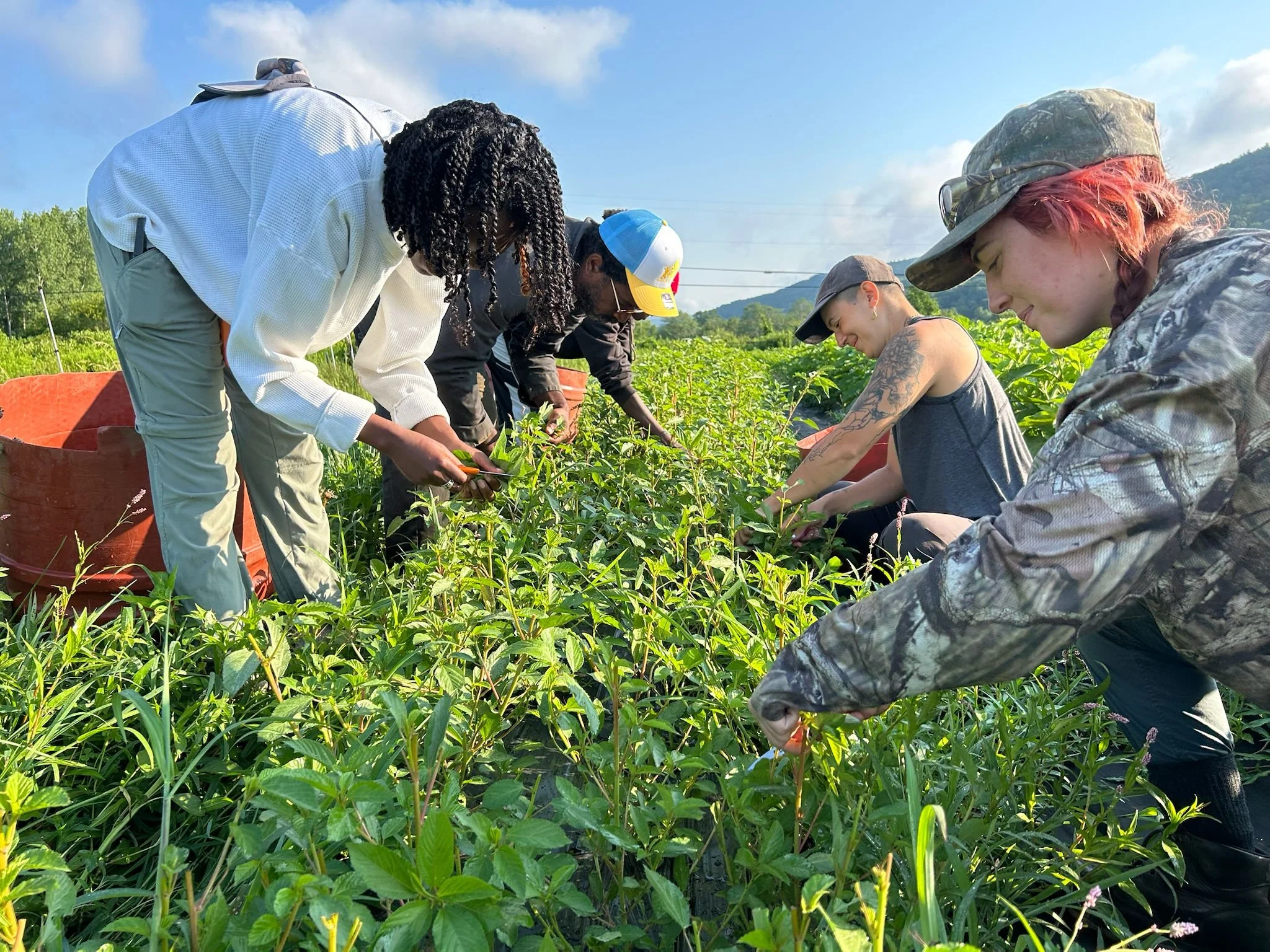
Going Far, Together: A $15M Collective Vision for Food Sovereignty
Discriminatory policy is often the jumping-off point for transformative collective action, and eventually innovation.
Our new partner, Webatuck Valley Farm Collaborative (WVFC), is one such project. WVFC is the product of a partnership between three distinct agricultural operations: Sweet Freedom Farm in Germantown, NY, focused on feeding marginalized communities and people impacted by the prison industrial complex; Wildseed Community Farm and Healing Village in Millerton, NY, growing food and medicine as infrastructure for solidarity economies and centering BIPOC leadership and imagination; and Rock Steady Farm, a queer and trans-led multiracial worker cooperative, also in Millerton. Their work is a response to a deeply interwoven set of systems-level problems:
- Inequitable land access. Nationally, 15% of the population is African American, but less than 1% of US farmland is owned by the Black community — a disparity that shows up just as much in Hudson Valley farm ownership.
- Insufficient supply chain infrastructure. Eastern Dutchess County lacks the refrigeration capacity, commercial kitchen space, and processing capabilities WVFC’s farms and regional partners need to maximize their impact. Rock Steady had to downsize their CSA and farmer incubation offerings because of limited cooler space. Food is lost, instead of being upcycled into value-added products. And their ability to diversify offerings and sell year-round is constrained.
- Limited food access. Félicia Wong, from WVFC, says: “The main choice point when starting a farm here is that you have to decide if you’re just going to sell to the highest dollar buyer, or do a farmers’ market in the city, which diverts food and excludes communities in surrounding rural areas...We’re creating a future where you don’t have to make that choice.”
These challenges don’t stop at WVFC’s founding farms — they cascade down to the 100+ other producers they collaborate with across the state, plus the partners that make up their regional distribution coalition, like Brooklyn Packers, Catskill Agrarian Alliance, Choy Commons, Chester Agricultural Center, and Essex Food Hub.
Structural barriers often necessitate creativity. One example: The land that new farmers with limited economic resources can access tends to be devoid of rich, grow-ready soil, so they are forced to rebuild the soil health from the ground up. “Building soil, if we’re boiling it down, is just more affordable” in the long-term, according to Félicia. “Jalal Sabur and his team at Sweet Freedom Farm grow sorghum as a cover crop, but sorghum is a multi-purpose ancient African grain. It not only sequesters carbon, it builds silica in the soil. And then you can harvest it and turn it into multiple value-added goods…We’re working with what we have, and what we have is not a lot. So we’re finding creative solutions.”
Fittingly, as the African proverb featured on WVFC’s website goes: “If you want to go fast, walk alone. If you want to go far, come let’s walk together.” Creativity alone isn’t enough — structural barriers also demand collective response. Through their New York Foodways community, a collective plan with massive ambition was seeded back in 2023: the renovation and expansion of multiple food hubs, including a $15M food hub campus in Millerton, NY — purpose-built to serve the queer and BIPOC farmers of their community.
The project will create an aggregation point for producers across Dutchess and Columbia Counties in New York, as well as neighboring farms in Connecticut and Massachusetts. The site will add much-needed refrigeration capacity and support a state-wide distribution network co-built by WVFC. A commercial kitchen and processing facility will allow for otherwise-unusable byproducts to be upcycled into pancake mixes, sauces, pickles, and other shelf stable food products. Aggregation means a large community of small producers growing a crop like garlic can combine harvests and viably compete for larger contracts — like schools or hospitals — that otherwise would be inaccessible. “Farmers can cut the cost of production through the use of the shared food hub infrastructure and delivery systems, increase year-round product offerings, and expand alternative sales channels that center lower-income community members and institutions,” Félicia explains.
We’re excited to partner with WVFC in financing the project, and enabling our partners to participate too. Their $15M fundraising goal ($5.7M has already been raised) relies on grant funding and private donations. A Walden loan will help bridge the cashflow gap associated with grants that rely on reimbursement, and Walden partners can support by opening a 24-month WVFC Local Impact CD. Terms and conditions apply — learn more about this opportunity here.
Not a Walden partner yet? Now through December 31, 2026, we’ll make a $100 donation to WVFC on your behalf when you open an account with promo code “WVFC”.*
You can also donate directly, or learn more at their upcoming Funders Briefing on October 6th. Details here.
