Food & Agriculture
The Farmers Land Trust
Securing Farmland for the Next Generation of Stewards
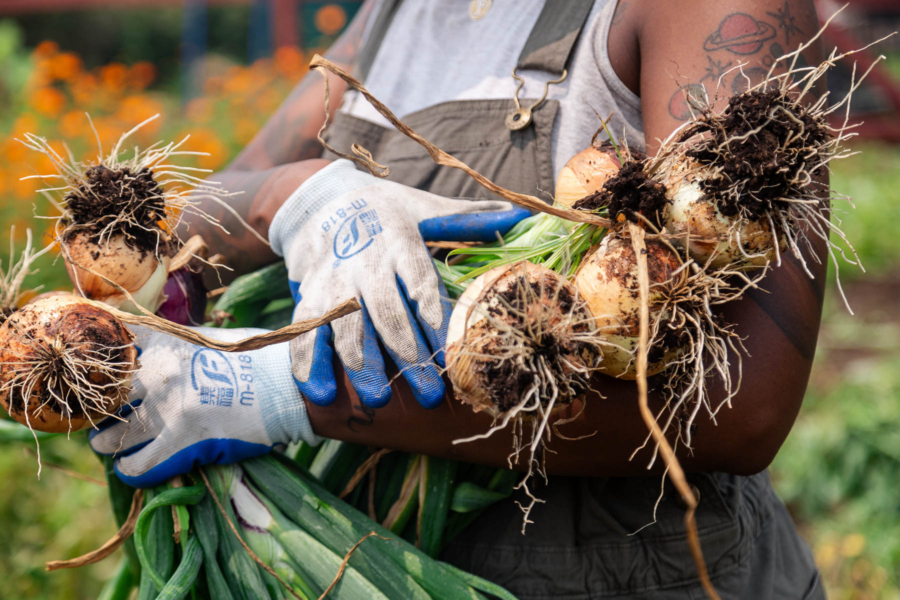
Alita Kelly, founder of Jade Rabbit, is now operating Blue Cocoon Farm on 19.9 acres in Bangor, Michigan. Earlier this year, she became its steward through a 99-year lease — the first farmland in the country transferred through The Farmers Land Trust’s Farmland Commons model. The land previously belonged to Julian Lauzzana, who could have sold it with no guarantee the 20-acre permaculture property would remain farmland. Instead, he donated it to The Farmers Land Trust — a nonprofit established to preserve farmland, so farmers, like Alita (a leader of the West Michigan Young Farmers Chapter), can work the land without having to buy it, refinance it, or lose it to the highest bidder.
For first-generation farmers, buying land outright is often out of reach, as for decades real estate prices have climbed faster than farm income. Renting land isn’t significantly more affordable either — it doesn’t offer much security or a path to building equity. While access to land is a significant hurdle for new farmers, those farmers nearing retirement often struggle to find a buyer who can afford their land. According to the USDA’s 2022 Census of Agriculture, the average age of U.S. producers is 58, and over a third are 65 or older. With so few eligible buyers, farmland increasingly ends up going to developers, rather than the next generation.
The Farmers Land Trust’s first Annual Report lays out the scale of the problem: 70% of the country’s farmers and farmworkers are people of color, yet they own less than 2% of the land, and an estimated 300 million acres (the largest private transfer of farmland in U.S. history) will change hands over the next decade or two. Most land trusts protect land from development. The Farmers Land Trust’s goal is narrower, and, arguably, more challenging — keep land permanently in farming and ensure it isn’t reserved for only those who can afford it.
Their solution, Farmland Commons, is a network of localized affiliate nonprofits that hold donated or purchased farmland, and lease it (for 99 years where state law allows) at a fraction of a mortgage payment and ultimately just for real estate carrying costs and an Indigenous payment — with some leases written to be inherited across generations. Founded in 2023 by Kristina Villa and Ian McSweeney, The Farmers Land Trust has launched seven Farmland Commons nationwide, each built around regenerative, organic, and biodynamic practices. “Our Farmland Commons are people saying land should be held differently,” Ian says, “that we should value land for regenerative practices and long-term stewardship, not extraction and corporate benefit.” This August marked three years since the organization’s founding, and their Annual Report touts much success worth celebrating, like year-over-year revenue growth north of 100% and two farms (20 acres in Michigan, and 43 in Wisconsin) gifted outright, worth nearly $600,000 combined.
At Walden, we’re grateful for The Farmers Land Trust’s partnership. Our two organizations are complementary — their innovative structure preserves agricultural land and holds it in community (similar to the mutual model), while ours unlocks expanded pools of capital (deposit dollars like yours) for investment in the same ecosystem. One organization’s success is a tailwind to the other.
Back in Bangor, Alita is tending the land with the security of her 99-year lease. The Farmers Land Trust aims to repeat this success story at scale with 30 farms across 22 states within five years, and more than 100 farms in all 50 states within ten.
To support this work directly, you can donate to The Farmers Land Trust here. Not a Walden partner yet? Use the promo code “FARMLAND COMMONS” when you apply for a new account between now and December 31, 2026, and we’ll make a $100 donation to The Farmers Land Trust.*
Read The Farmers Land Trust’s full Annual Report on their site.
*Terms and conditions apply.