Results

Our Impact Metrics

Partner Borrowers

Metric 2023 2024 2025
Number of Loans in Portfolio Attributed to: [1]
BIPOC 14% 30% 13%
LGBTQIA+ 17% 15% 13%
Women 61% 61% 31%
Number of New Loans in Portfolio Attributed to:
Small Farms [2] 27% 22% 13%
Low/Moderate Income Areas [3] 16% 21% 13%
Loans Where We’re the Only Offer 14% 47% 40%
Acres of Farmland Funded 7,459 141.5 576
Walden Impact Assessment Submissions 36 33 16
Walden Impact Assessment Change in Average Score [4] -1% -5% +23%

Number of Loans in Portfolio Attributed to: [1]

BIPOC

202314%

202430%

202513%

LGBTQIA+

202317%

202415%

202513%

Women

202361%

202461%

202531%

Number of New Loans in Portfolio Attributed to:

Small Farms [2]

202327%

202422%

202513%

Low/Moderate Income Areas [3]

202316%

202421%

202513%

Loans Where We’re the Only Offer

202314%

202447%

202540%

Acres of Farmland Funded

20237,459

2024141.5

2025576

Walden Impact Assessment Submissions

202336

202433

202516

Walden Impact Assessment Change in Average Score [4]

2023-1%

2024-5%

2025+23%

[1] In our infancy, much of our work has centered on developing and refining our lending strategy. As that strategy matures, we're largely reacting to the shape of our pipeline rather than proactively shaping it. Our equity metrics (such as the percentage of new loans made to BIPOC, LGBTQIA+, and female operators) reflect this dynamic. These figures have fluctuated year over year, but we expect them to stabilize and improve incrementally as our sales culture continues to develop.

[2] Developing a more concentrated agricultural practice area is a top priority in 2026. After funding a wide range of farms in 2023 (reflected in our share of new loans to small farms and total acres of farmland funded) our activity shifted toward other sectors, including food brands, clean energy, and nonprofits. Going forward, we expect agriculture to represent a growing portion of the portfolio.

[3] The fluctuation in our share of new loans in low- and moderate-income areas reflects a reactive posture rather than a deliberate strategy, and should stabilize as our approach becomes more proactive.

[4] We saw a meaningful increase in the average score of borrowers' impact assessment submissions. Standout performers included Organic Nuna (100% normalized score), LeBlanc Family Farm (95%), and Maker Wine Company (84%).

Commentary

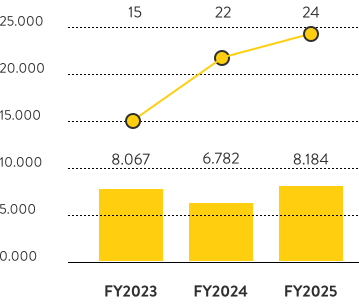
Despite 60% headcount growth since 2023, emissions per employee have remained relatively stable –we’ve managed to grow our team without proportionally scaling our carbon footprint.
Total emissions intensity has dropped significantly –from 160%  in 2023 to 119% in 2025 –driven by assets out growing emissions; scope 1 and 2 intensities have both roughly halved over the three years.
Our Scope 3 emissions are calculated based on our spend within our supply chain (primarily technology vendors). Financed emissions –or the emissions of the organizations we made loans to –are not included in the Scope 3 calculation.

Individuals

Metric 2023 2024 2025
Summer Farm Dividend Redemption Rate 17.9% 18.5% 20.9%
Special Deposit Dividend Rate 0% 0% 0%
Core Deposit Interest Paid Relative to Market 6.3x 6.2x 6.7x

Summer Farm Dividend Redemption Rate

202317.9%

202418.5%

202520.9%

Special Deposit Dividend Rate

20230%

20240%

20250%

Core Deposit Interest Paid Relative to Market

20236.3x

20246.2x

20256.7x

Ourselves

Scope 2023 2024 2025
B Impact Assessment Score
Administered Tri-Annually
108.2 -- --
Total Emissions 121.0 MTs 149.2 MTs 204.6 MTs
Scope 1 – Sources Controlled or Owned by us 9.2% of total 6.9% of total 5.9% of total
Scope 2 – Indirect Emissions from Purchased Energy 2.8% 2.0% 1.6%
Scope 3 – Indirect Emissions Affecting Value Chain 88.0% 91.1% 92.4%
Full time Equivalent (FTE) Employees
At time of publishing
15 22 24

B Impact Assessment Score

Administered Tri-Annually

2023108.2

2024--

2025--

Total Emissions

2023121.0 MTs

2024149.2 MTs

2025204.6 MTs

Scope 1 – Sources Controlled or Owned by us

20239.2% of total

20246.9% of total

20255.9% of total

Scope 2 – Indirect Emissions from Purchased Energy

20232.8%

20242.0%

20251.6%

Scope 3 – Indirect Emissions Affecting Value Chain

202388.0%

202491.1%

202592.4%

Full time Equivalent (FTE) Employees

At time of publishing

202315

202422

202524

Emissions Efficiency Per Employee

Combined chart showing full-time employees increasing from 15 in 2023 to 22 in 2024 and 24 in 2025, while emissions per employee decrease from 8.067 metric tons to 6.782 and then increase to 8.184 metric tons.Combined chart showing full-time employees increasing from 15 in 2023 to 22 in 2024 and 24 in 2025, while emissions per employee decrease from 8.067 metric tons to 6.782 and then increase to 8.184 metric tons.
Number of full-time employees
Metric Tons of CO2/Employee

Scope Emissions % of Total Assets

Line graph showing emissions by scope from 2023 to 2025: Scope 3 remains highest, decreasing from 140.85% to 109.82% and then rising slightly to 110.08%; Scope 1 decreases from 14.73% to 8.32% and 7.03%; Scope 2 decreases from 4.48% to 2.41% and 1.90%.Line graph showing emissions by scope from 2023 to 2025: Scope 3 remains highest, decreasing from 140.85% to 109.82% and then rising slightly to 110.08%; Scope 1 decreases from 14.73% to 8.32% and 7.03%; Scope 2 decreases from 4.48% to 2.41% and 1.90%.
Scope 1
Scope 2
Scope 3